
Donations are purchase behavior. Someone decides, in a moment, to do something with their money. That decision is influenced by trust, attention, emotion, and timing.
For years, nonprofit marketing conversations have gotten stuck in a false debate: TV vs digital.
But the data is pointing to something simpler and more useful for 2026:
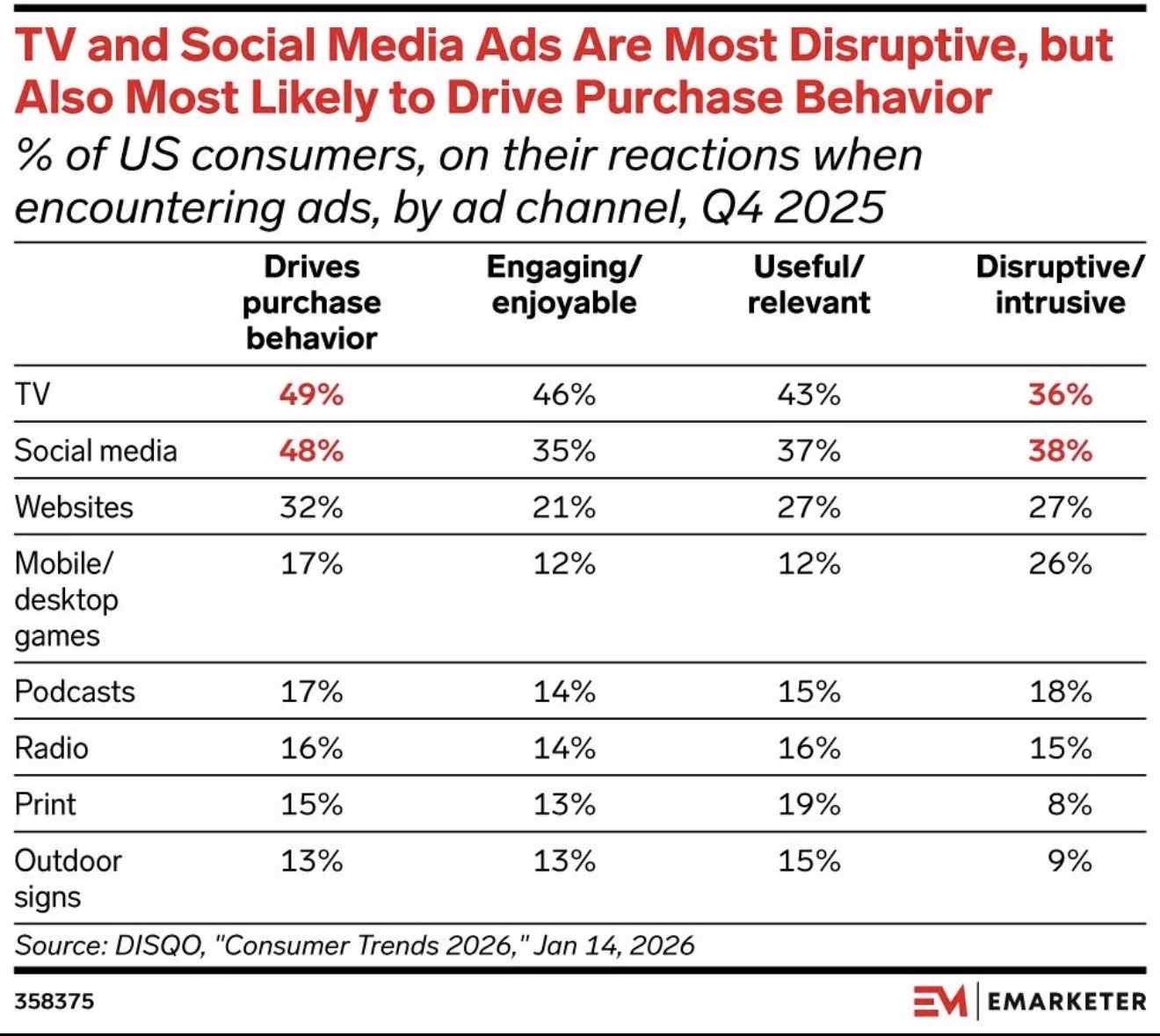
TV and social are the two channels most likely to change what people do next. (EMARKETER)
So the opportunity is not picking one. It is building a system where TV creates momentum and digital captures and compounds it.
TV still moves people, even when they say it disrupts them
Consumer research from DISQO (surveying 3,000+ US consumers in Q4 2025) shows 49% of consumers say TV ads drive purchase behavior, with social close behind at 48%. (EMARKETER)
That matters for nonprofits because we are not only competing for attention.
We are competing for action.
And action does not start at the donation form. It starts earlier, when someone decides your mission is credible enough to trust.
The donor problem is not clicks. It is keeping donors.
If you are measuring success purely by traffic, you can accidentally build a leaky bucket: lots of first-time gifts, not enough second gifts.
Donor retention continues to fall. In the Fundraising Effectiveness Project’s Q4 2024 report, new donor retention declined year over year, with one in five donors who were new in 2023 giving again in 2024. (publications.fepreports.org)
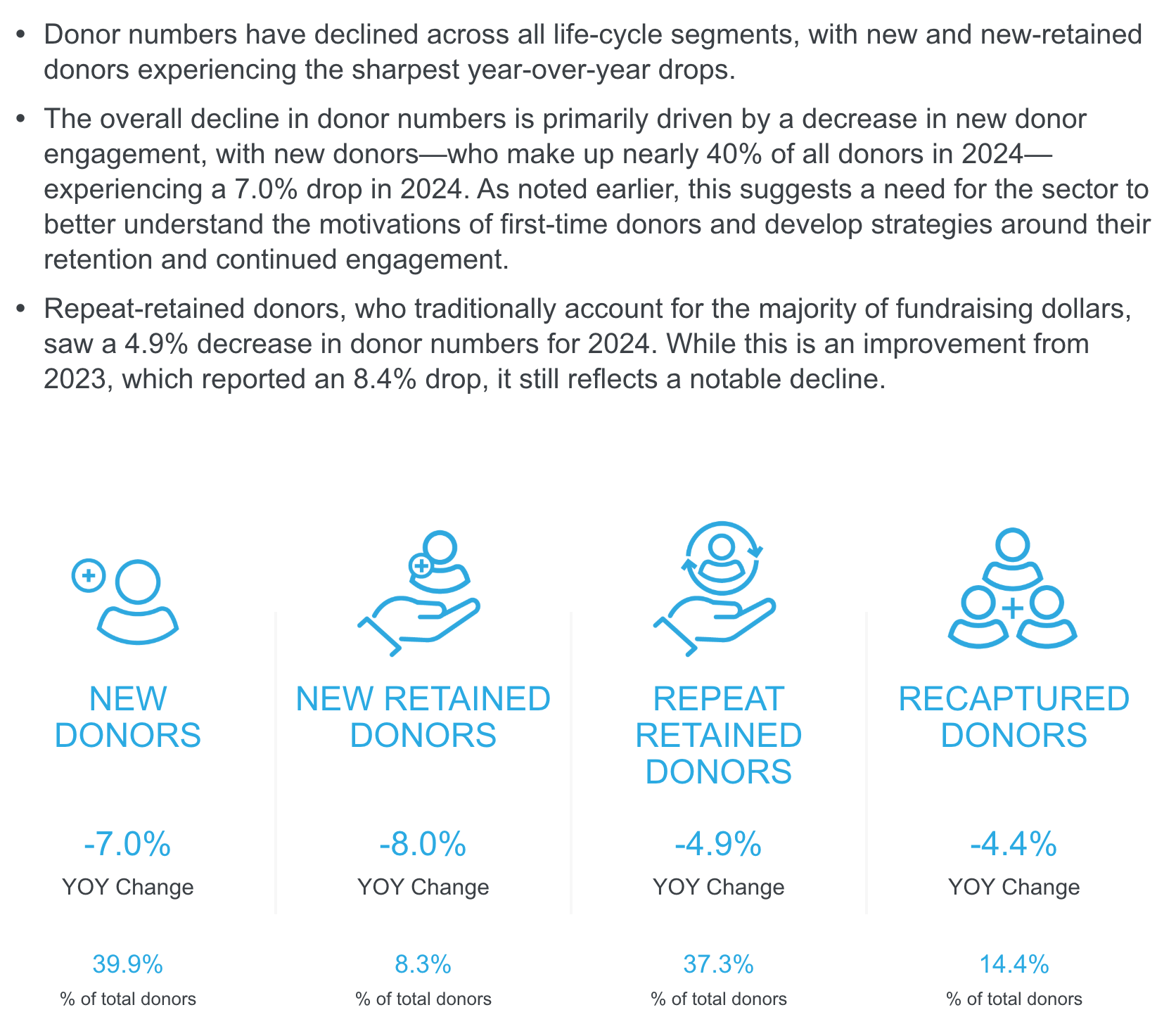
Year-to-Date Nonprofit Sector Trends - Q4 2024 (JAN 1, 2024 - DEC 31, 2024) - https://publications.fepreports.org/archive/usa/2024/q4/#close
That is the real emergency in nonprofit growth.
Not reach. Not impressions.
Durable giving.
Monthly giving is the growth engine
If retention is the problem, recurring giving is the answer.
M+R Benchmarks reports that in 2024:
Monthly giving revenue increased 5%
Monthly giving accounted for 31% of all online revenue (M+R Benchmarks 2025)
This is why donor growth is a journey. Your job is not just to get the first gift. Your job is to build a path from:
awareness → first action → second action → monthly commitment
What nonprofit marketing should look like in 2026: one system
The winning strategy is not “CTV vs digital.”
It is TV + social working as one connected system.
A practical way to think about it:
TV is your trust and attention engine.
Social is your follow-through engine.
When they run together, you get higher quality donors and a clearer path to recurring giving.
Here is a practical playbook you can actually run.
1) Use TV as the new top of funnel for donors
TV combines sight, sound, and in-home presence. It is high attention media, and it is increasingly where audiences live.
Connected TV context for nonprofits
“Total advertising investment by nonprofits increased by 11%. Spending on connected TV advertising increased by 84% in 2024 and made up 15% of fundraising advertising budgets.” – M+R
(https://mrbenchmarks.com/key-findings)
2) Tell a story that earns attention and trust
Before you ask someone to give, you have to make them care.
For nonprofits, story is not “creative.” It is the mechanism that drives engagement and makes the next step feel worth taking.
TV is especially powerful here because it lets you build belief in a full screen, sound-on environment. Social then reinforces that story and keeps it present long enough for someone to act.
What this means in practice:
Lead with a human truth, not an organizational description
Make the mission specific (one person, one community, one clear need)
Show the change a donor enables (what gets better because they gave)
Keep the message focused so the audience remembers it
When story is clear and it taps into the viewers emotions, the next step becomes easier.
3) Make the next step really simple
CTV is not a click environment. Your job is to remove friction
One clear action
A short, readable URL
A QR code (when appropriate)
A dedicated landing page that matches the promise in the ad
The goal is not to explain everything. The goal is to earn the next step.
4) Use social to retarget and convert
Once someone has seen you on TV, social becomes more efficient because the trust barrier is lower.
This is where social does what it does best:
Remind
Reinforce
Convert
You are not running separate campaigns. You are running one journey across two screens.
5) Push monthly giving early after the first gift
The moment after a first-time donation is when intent is highest. That is when you introduce stability:
A simple thank you
A clear proof point of impact
A gentle monthly ask (present, not pushy)
Because donor stability lives there.
The takeaway for 2026
Nonprofits do not need more channels. They need fewer, working together.
TV creates belief.
Social turns belief into action.
Monthly giving turns action into stability.
If you are a nonprofit considering buying Streaming TV media, reach out to AdGood!
Most nonprofits do not need another platform. They need an operator who already understands how to run TV responsibly and report results credibly.
AdGood is a 501(c)(3) nonprofit built by Streaming TV technology veterans who not only are experts in the Streaming TV space, but helped build it. Our mission is to bring affordable premium streaming TV access to all nonprofits.
If you are ready to add CTV to your donor growth journey, we will help you launch the right way.
