
Where CTV Fits in a Nonprofit Fundraising Strategy
Nonprofit fundraising rarely works in a straight line.
Most donors do not see one message, click once, and give immediately. More often, they notice an organization, hear a message a few times, recognize the name later, and act when the timing is right. That is why fundraising works best when channels support each other instead of competing with each other.
Connected TV fits into that mix as a channel that builds awareness, credibility, and memory at the top and middle of the donor journey. It is not meant to replace email, direct mail, paid social, or search. It is meant to make them work harder.
That matters even more now because streaming is where people are spending their time. In January 2026, streaming accounted for 47.0% of total TV usage in the U.S., making it the largest share of television viewing. Nonprofits are moving there too: M+R reports that nonprofit spending on connected TV advertising increased 84% in 2024 and made up 15% of fundraising advertising budgets.
CTV is not the whole strategy. It is the force multiplier.
A lot of nonprofit teams still feel pressure to judge every channel by immediate last-click donations. That is understandable. Fundraising budgets are tight, and teams want clear proof that something is working.
But CTV tends to do something different and often more foundational. It helps more people know who you are. It helps your message feel more credible. And it gives your mission room to land on the biggest screen in the home, in an environment people intentionally chose to watch. Nielsen’s data is the clearest proof that this environment matters simply because it now commands the largest share of TV viewing.
For nonprofits, that makes CTV especially useful as a trust-building channel that strengthens the rest of the fundraising system.
Where CTV fits best
The simplest way to think about CTV is this: it creates recognition before other channels ask for action.
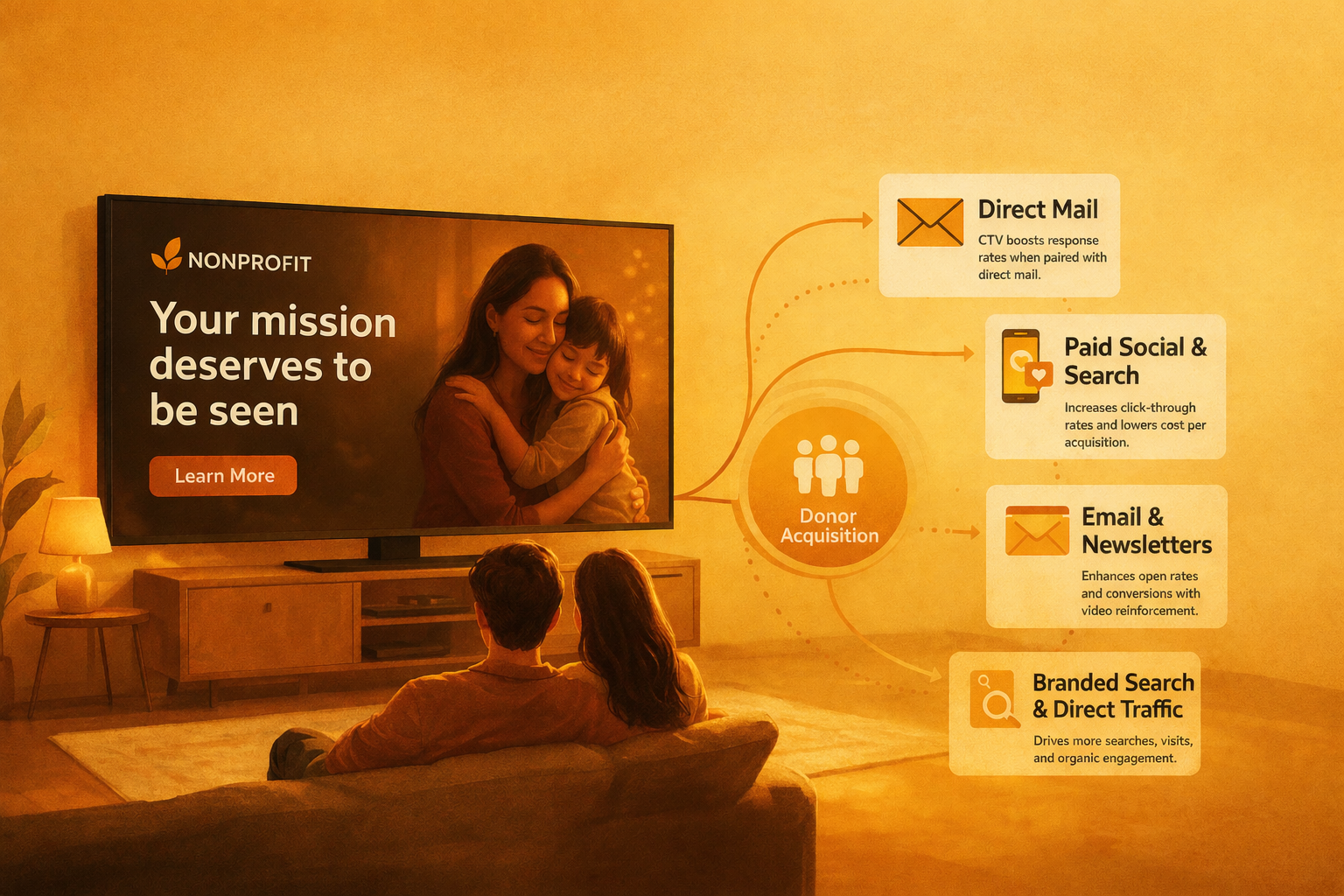
A supporter might first see your nonprofit through a streaming TV ad. Later, they may respond to a direct mail piece, click a paid social ad, search for your name, visit your site directly, or finally donate through email. That is not a failure of CTV. That is often exactly how donor behavior works.
M+R’s glossary even includes “view-through revenue” as a fundraising concept: revenue from donors who make a gift after seeing, but not clicking, an ad. That is a useful framework for nonprofits because it reflects what many mission-driven campaigns are really doing: influencing action that happens later, not only capturing clicks in the moment.
How CTV supports the rest of the fundraising mix
Email is still one of the most important channels in nonprofit fundraising, but it works better when the organization already feels familiar. CTV can help create that familiarity before an appeal lands in someone’s inbox. M+R reports that nonprofits raised $58 for every 1,000 fundraising emails sent in 2024, which makes email important, but also suggests every email has to work hard. CTV can help warm that audience first.
Direct mail
Direct mail often performs best when the recipient already recognizes the organization. CTV can help build that recognition before a mail piece arrives. For many nonprofits, that means direct mail becomes less of a cold introduction and more of a reminder.
Paid social and search
CTV can also support channels built for response. Search is where people go when interest turns into intent. M+R found that search advertising had the highest return on ad spend among the nonprofit ad channels in its 2025 Benchmarks reporting, at $2.23 ROAS. That makes search a strong capture channel. CTV can help create the awareness that leads to more branded search and better response later.
Website and direct traffic
One of the clearest early signs that CTV is doing its job is often not a flood of tracked donations. It is an increase in branded search, direct visits, and more qualified traffic from people who already know your name when they arrive.
Why this matters for donor retention
This is not only about acquisition. It is also about building a stronger relationship with the people you do reach.
The fundraising environment remains difficult, especially when it comes to retaining donors. The Fundraising Effectiveness Project reports that only 14.0% of new donors from 2024 had been retained year-to-date in 2025, while repeat donor retention was 43.6%. In other words, turning first-time donors into lasting supporters is still one of the hardest parts of fundraising.

That is part of the case for CTV. When used well, it helps nonprofits show up more clearly, more credibly, and more consistently. It can help make the organization feel known before the next ask. And in a market where donor trust and recognition matter so much, CTV could not me more essential.
What nonprofits should expect from CTV in the mix
CTV is usually not the channel that does everything by itself. It is the channel that helps the rest of the strategy work better.
A good nonprofit CTV campaign can help:
increase awareness among the right audiences
improve recognition before a donor sees an email or direct mail appeal
support stronger branded search and direct traffic
reinforce trust across the fundraising journey
give the mission a more premium, memorable presence
That is where CTV fits in a nonprofit fundraising strategy. Not as a replacement for response channels, but as a way to make them more effective.
For nonprofits, that is the real opportunity: using streaming TV to make the whole fundraising engine stronger.
